Life Back Outside the Comfort Bubble
The Good Shit Sticks
Long ago I learned that you can’t make up the really good stuff. Now, I am a writer, and I tell stories. I have learned that there are techniques and things to do to make a bad story good and a good story better, but you can’t make up the really good stuff. For proof I offer my short but true story The Cake Incident. Today there was a mish-mash of events so interrelated it amazed even me. But it started last week.
Last week I was trying to figure out how to use my 109 hours of Use or Lose Leave. As the name implies you either use it or you don’t. What I discovered, honestly by accident, is that no one you talk to takes sympathy on you when you try to describe how hard it is to schedule two and a half weeks off. The most common “help” that I got was “You can donate some of those hours to (fill in name here)” which came from more than one person. I get it, it’s rough to be me. Never forget though that if we could all put our troubles in a big pile with other people we’d happily pick ours back out of the pile instead of theirs. On to today.
Today I had an in-depth conversation about Poland with a coworker. I talked of the beauty of the country, the excellent exchange rate, an incredibly detailed bit about Polish history to include why it has been wiped off the map so many times, even espoused the stark and sterile beauty of the communist architecture that remains in places, and mentioned it is one of my favorite European countries. It is cold, and I don’t want to live there, but it is beautiful. The other individual has a Polish fiancé so perhaps the man-crush conversation was driven by ulterior motives on the other end of the phone. The ability to have such a conversation with someone else is stop in your tracks amazing. I’m not talking about things I’ve read, heard, or seen in movies or on television. Rather places I have seen and been to with my own eyes. I have touched the soil, breathed the air, discussed the history, spoke some of the language all inside this far away place I never dreamed I would be able to see. The grandiose visions of the future I had in high school never included the ability to have experienced such a thing. And high school itself was on the forefront of my mind today as I heard two different songs on two very different radio stations that were both released in 1989. Again, I get it. It’s rough to be me.
At lunch today a German colleague said to me, “In a perfect world. . .” As he continued to talk, I looked around the room and outside the window then interrupted him to say, “Peter, we are in Germany. It IS a perfect world.”
Tonight, Faith asked me what my favorite continent is. I’ve been on three. I’m not bragging, I know people who have been on six and I’ve met people who have been on seven. People who know me know that I am an American by birth, Southern by the Grace of God kind of guy. A dyed in the wool, unapologetic, arrogantly proud Southerner who busts all kinds of stereotypes because I have seen as much as I have of the world. It is only a start of what I plan on seeing though. Again, I get it, it’e rough to be me.
If I could have only one wish for everyone that has ever read anything I have written it would be that you could join me in the surreality of the last parts of this story. Travel is fatal to prejudice, it is good for the soul. Seeing the United States of America from the outside can provide a viewpoint that is simply incredible. Cal Fussman, a podcaster I listen to (and encourage everyone to hear), once talked of meeting a famous author who stayed drunk. I want to say it was Hunter S. Thompson but that isn’t right. Cal asked him how he could work drunk and not forget the good stuff. To which the author replied, “The good shit sticks.”
I can’t offer everyone a free ticket, but I can offer a free place to stay, a home base if you want it. Come on over to see the good shit. It’s all good shit, and it’ll stick.
For good measure I’ll hope you also get the problem of too much leave at least once, too. Though when I say that I run the risk of sounding like I’m bragging.
What is Writing
If writing is writing, and thinking about writing is writing, then what is writing about writing to keep from writing? Writing?
That sentence started out to be less nonsensical but ended up like my favorite grammatically correct yet seemingly nonsensical sentence. Buffalo buffalo Buffalo buffalo buffalo buffalo Buffalo buffalo. But even that sentence reiterates the conundrum of the first paragraph.
Thanks to Norman R. Augstine we all know that "Simply stated it is sagacious to eschew obfuscation." But is the word buffalo repeated 8 times obfuscated or sagacious due to its economy of words and power of its precise terms? An American bison from the town in western New York that is intimidated by other American bison from the same town in western New York also tend to intimidate American Bison from western New York. Or is it puzzled instead of intimidated? Or is it upstate instead of Western? Or is it an just an oxlike mammal and not a bison? Or are there even bison in New York? Is it more succinct to use 8 words than to use 35 to describe the same thing, especially if all three of the words that are the same word have different definitions other than just the fact that they are 3 different words that are the same?
Powerfully succinct, vaguely precise, or generally specific the sentence and the question remains. Is writing about writing as a distraction to keep from writing, writing?
So what keeps me from writing? It isn't that I think my writing stinks. Parts of it do, but overall I think I'm the most humble person you'll ever meet. Not one of the most, the most period. As a result whatever drivel I spew must be high quality literature on a par with Hemmingway, Faulkner, and Borges.
My writing needs work. It needs an editor, it needs a content editor. I would even relish and appreciate an editing. It isn't perfect, far from it, but it isn't the rantings of a confirmed lunatic. There is purpose and meaning, and even subtle meanings deep in the story, plot, and characters. It is literary styled if not literature. And that in itself is a bit of a rub.
No one wants to read literature. No one. Everyone wants to have read literature. I had to re-read that the first time I saw it. But the third time I read it I got it. I wanted to have read before i read it, but having read it I got it. Which is the way literature works at times. Those not educated in the nuances of allusion, metaphor, similes and the like can easily dismiss the need for such an education. Once educated though, the importance, indeed the pleasure that can be derived from such a training is clearly evident. Even though the underlying desire to have done rather than to actually do may still remain.
So it isn't fear of perfection, my writing isn't. It isn't fear of rejection, even if it is. It's not a lack of ideas. So what is left?
I began his post last weekend, clearly as a distraction to keep from writing. But this morning it hit me, writing is like golf. By which I mean two distinctly different but very important things. My golf handicap is that I think I am a golfer. I spoiled a long walk (for Twain fans) in over a decade but when your score gets to be so high it is becomes a primer in math it becomes discouraging and makes you want to quit. And then it happens. You hit one shot so beautifully perfect it makes you say, "I'll be back."
The best thing about golf though is something I found and have stolen so long ago I cannot credit the person who said it. In the game of golf you find your self on some dewy morning or balmy afternoon standing in a manmade meadow and you realize: Any man can make a golf ball white, but only God can make the grass green.
Labels
One problem I see rampant in our culture today is the desire to label anyone we meet and talk with (whether it's virtual or face to face) in a manner that classifies them. "Oh, you're a _____." These all-encompassing labels will allow us to know your political affiliation, ideology, religious beliefs, what kind of work you do, which side of the bed you sleep on, whether the toilet paper rolls over the top or correctly, and sometimes even what colour your underwear is. But these same labelers when asked what label fits them will say that they don't fit just one label. "I'm a new urbanist, civil, contrarian, neo-classical baroque, Hungarian-Irish, chi-peek-a-doodle Centrist."
A corollary to this problem is that more often than not if you speak disparagingly of what group that makes you a member of the polar opposite. For example, if you insult a Democrat you must be a Republican. Or the more important, if you make joke that has the University of Alabama at Tuscaloosa as its focus you must be an Auburn fan. This also is not necessarily the case. (Just in case my favorite joke is when the cashier invites me to the express lane because they aren't busy but I have too many items and I ask if I have to act like an Auburn graduate that can't read or an Alabama graduate that can't count?)
My point here is of course dual but the main one is that we want to believe that we are multi-faceted but others are so easy to understand that one label covers all. That is almost certainly not the case. My second point is much less obvious.
I work with a German who is mostly a very typical German. He plans, he is prepared, he is on time, he doesn't break the law even if it's a stupid law like not killing the massive nest of hornets I have in my shed, and he puts his cellphones in the back seat of the car when he drives to keep from being distracted. While it sounds very spur of the moment to say he got married in Las Vegas, it actually was a very well planned out event when he and his wife toured the western United States and stopped where they arranged to get married in Vagas.
He is atypical in that he drives a lot. He actually drives more than I do, probably more than I drove in my last job where my daily commute was 1.5 to 2 hours one-way. We have driven many times together. Our trips to Wiesbaden or Garmisch are 3.5 hour trips one-way if we don't hit traffic. Driving through Wurzburg, Frankfurt, and/or Munchen we almost always hit traffic. When we started traveling together 2.5 years ago I would have my phone connected to the car's bluetooth but after a year or so he connected his to the car if he was driving.
Another atypicality of his is that he has never gotten a speeding ticket. Here in Germany they have speed cameras to give tickets. In speaking with a German lawyer on a different subject I mentioned a ticket I had received and he said, "Drive like a German. You'll get a ticket, pay it, and forget about it." Germans tend to get their licenses much later than Americans. He is six months older than me, but I got my license at 15, he did not. Partly this is because to get a license in Germany costs over 1000 Euros. The advantage is that their insurance is much cheaper. It should be, they can drive unlike us Americans with our cheap licenses and expensive insurance.
So it came as a surprise Friday when he told me he may have gotten a speeding ticket. You don't know until something gets mailed and since he was driving one of the vehicles I am signed for the notice comes to me. It arrives with a picture as well as the date and place so I can easily know to whom I need to send it for payment. I didn't think much of his revelation until a few minutes later when he said, at least I had the phone connected to the car so I wasn't holding my Blackberry to my ear. That would be a real sin in Germany. Another German I know got pulled over for just looking at his Handy (what Germans call their cellphones) while driving. Getting pulled over is a rarity because there are not roving bands of Polizei like we have in the US. They don't need to with speed cameras, and red-light cameras, and law abiding citizens. I may have mentioned before, in the US we will say, "That is the best law any politician has ever passed. I'm not going to obey it, but it's a great law." In Germany they say, "That's the stupidest law that anyone could have ever passed. It's so dumb we don't know how they dreamed it up. I mean, we're going to follow it, but it's dumb." And yes, those three sentences probably contain at least four 8 letter words that sound like you're angry when you say them even if you whisper.
A minute or two later in my conversation my friend revealed to me that his problem, and why the camera may have caught him, was that he was trying to connect his laptop to his iPhone for a data connection. This caused me to come to a full stop. I clarified, "You were speeding, because you were talking on your bluetooth, while trying to connect your laptop to your iPhone to access an email for a number?"
"Yes, for a conference call. The number was in an encrypted email," he said. We can't see encrypted emails on our Blackberry but to see it he would not only have to connect the phone to the laptop but log into the VPN and pull up the email. A third-order distracted driving task that only the most experienced should never attempt.
Shaking my head I said, "I'm wearing off on you the wrong way. You don't even sound German when you say that. I mean, you sound so American I think you'll be voting in the mid-term elections in November."
"Is that all it takes?" he asked.
"Pretty much," I said, "And if you're dead you could vote Democrat twice."
In answer to your unspoken question, no I have never been called right in the head.
Overthinking
For those that know me, you know I have a lot of information rumbling through the blank space beneath my hat. The least little thing is likely to start me talking about something that seems so incredibly off subject that right about the time you lose interest (or sometimes well after) I hit on something that smacks right back to the subject at hand that spun me into the original tangent. A had a friend once tell me they wished they could be inside my head for a day. I asked them why, because there are times I don't want to be inside my own head.
All the world is one big connection. The more of this great big giant globe I see the smaller it becomes. But the other thing that happens as I see more of the world is that I see what drives some of the world and definitely get a small glimpse of what drives us crazy Americans.
When I first started working for a government entity I was appalled at the lack of urgency and sense of leaving something undone. In my defense, I had worked for almost a decade at private consulting firms where the rules of capitalism mean that if you don't please your customer he isn't your customer long. My last job before government work was one where I learned the most about this because I spent a lot of time working alongside the President of the company who would ask me on Thursday what the client had demanded we have done by Tuesday. Not next Tuesday mind you, two days prior. I have long said that if it wasn't for the last minute I wouldn't get anything done, but Mark would not do anything unless it was critical mass and probably overdue. So comparing that to either the unspoken attitude of leaving it for tomorrow or the more brazen spoken, "It'll be there tomorrow" was a polar opposite.
Many even told me that I'd get there. My naiveté would wear off. My optimism would run out. But it hasn't. It still bugs me today when I have to deal with people that don't hustle, don't care, and simply don't get worked up over anything whether they need to or not.
Two and a half years later, I have finally realized that the attitude in Europe is one of "it'll be there tomorrow." Problems don't have to be solved today because they weren't made in a day and they won't be fixed in a day. The problem will be there tomorrow and we can nibble off a little more of that problem tomorrow. If we didn't finish it today and it's Saturday, we can do it on Monday because tomorrow is Sunday. The only two things open on Sunday in Germany are the churches and the restaurants and they don't open the latter until the former lets out. People here know that we work to live and we must live now.
Compare this to the United States and its live to work attitude. Fix it now and don't wait. Big or small issue it must be corrected now because there will be a new problem tomorrow. Now, faster, bigger, more efficient, less wasteful. Except of course for the things that are opposite. In those cases it must be slower faster, smaller in a huge way, more efficiently less efficient, and waste nothing in making it more wasteful.
Every time I hear someone say the US can have healthcare like Europe, or welfare like Europe, or like the article I read last week that said ALL it will take for the US to institute universal basic income is to increase our taxes to match Europe it makes me laugh. These people do not understand. They choose to see only a part of the problem, only a part of the solution, and fail to understand that their sprint to the finish attitude will not help them gain an edge on the marathon.
It is quintessential American idealism that we are stubborn and stuck in our ways. We unabashedly will not quit. Everyone should be like us because we're better, except for the things we are not better at. And those should be like someone who does that better, only we don't want to give up what they gave up to get it, because we are American. But wen're young.
Europe can wait until tomorrow because there was a yesterday for so long. I've long said that what is old in the US is still called new in Europe. There is a road in Grafenwoehr called Neue Amberger Strasse. The new road to Amberg. It replaced Alte Amberger Strasse (Old Amberg Street) because it goes through the Grafenwoehr Training Area. The infamous Tower of Tower Barracks is on Alte Amberber Strasse. So they needed a new road that didn't go through the military base when they started building the base--in 1908. Over 100 years and the road is still called New. In a town near me, Vohenstrauss, there is a castle built in the 11th to 12th century which has five towers. In the late 1800s they added a sixth tower to add in some indoor bathroom facilities. In the late 1980s, literally a hundred years later, as a part of repairing and updating the structure they tore down the tower because it was an add on. In Garmisch, the "new" church is 650 years old. It sits on the site of the old church which was there for 650 years.
In America a hundred miles is a short distance and a hundred years a long time. In Germany, a hundred miles is a long distance and a hundred years a short time. An attitude that is reflected in almost everything.
Editorial comment: I've updated quite a lot of things. Check out the new About the Website (added some new bits), and the links at the bottom (or the side) now go to some of my fiction work. Or just leave a comment. I would love to hear your thoughts on my thoughts. And thanks for reading this far. I cannot make you understand how much I appreciate that.
Another Birthday
It's that time of year again. Time for me to make my annual birthday post. And yet another re-telling of the greatest birthday present I have ever received. Back in June in another Outside the Comfort Bubble moment I sat at a table with 9 people who spoke English as a second language and tried to relay the story and STILL, 13 years later it chokes me up.
Many of the times I have posted this story I have used photos, which admittedly are powerful images of the destruction. But those photos do not truly show the intensity of the destruction. The sheer power of the 360 degree as far as the eye can see up, down, left, right, ahead, or behind, damage cannot possibly be relayed in a picture, only re-lived. There were other images burned in my memory from when I got to town the Saturday after, Seeing flotsam that was storm floated three stories high. Historic homes that had disappeared. Buildings that had been hit by floating casinos. Casino barges sitting atop former buildings. Beachfront property that did not even have debris left to comb through. The Church of the Redeemer bell tower foundation. The bell tower itself, the stalwart, unbreakable, unmovable icon that had withstood Camille, fire, lighting strikes, and my own childhood was missing. Picking up broken pieces of stained glass from the windows I had admired as a kid. Watching a helicopter and an LCAC land on the front beach. Powerful images that no photographer can capture but that make them want to try.
Katrina. The bitch that changed it all. No one who lived through the storm will ever forget, and most will remind those who didn't experience the storm firsthand to never forget that the storm did NOT hit the city of 400,000 plus to the west, it hit the coast of Mississippi. There were articles set to go out, and some already in the newspaper printers talking about how that town had dodged a bullet when the levees cracked.
Eventually the intensity of the storm was downgraded from Category 5 to 4 at landfall, but that was when it hit the dooey of Louisiana which turned the storm due north to Waveland. By the time it hit Mississippi it had downgraded to a 3 (because MS has never been hit by a Category 4). The reason the storm caused more damage than the biggest bitch Camille is that Katrina hit as the high tide was starting to go out. Her storm surge included extra water that was already at the high mark. But we didn't know that yet.
We all knew it would happen. When we legalized gambling in Mississippi we all said that we'd have one hurricane wipe the casinos out and they'd be legal on land. Technically it was two hurricane because Georges didn't do it. But likewise, we all knew what else would happen in the aftermath. In my interview with Fox 6 in Birmingham the Sunday after the storm on the grounds of missing church I had been baptized in at 1, the same spirit that kept people in their homes for the storm would cause them to rebuild afterwards. I said it may not be a month, it may be more than a year, but come back to Biloxi because it will be rebuild better than ever. It has been. It now is.
Thirteen years ago Wednesday, I lost contact with all but one of the family I had in the middle of Hurricane Katrina. My Dad, Mom, Uncles, Aunts, Cousins, there are too many to count. Predominantly they were in Biloxi, a few in Ocean Springs, one as far away as Diamondhead (near where the eye passed), but brackish blood runs through the Byrd veins.
The unwritten rules of hurricanes seem strange to most uninitiated. Cutting the grass the day before it hits, having an ax in your attic, calling everyone you know after the power goes out. I was at work 320 miles away as the storm hit, but still in contact with my family. My sister had half-evacuated. She left her home a half mile from the beach in Biloxi and went to her fiance's house in Saucier, maybe 10 miles inland. Mom, Dad, 3 uncles, 2 aunts, at least 2 cousins and a second cousin all stayed in Biloxi. Another aunt, uncle, and at least 2 cousins were in Ocean Springs watching the storm arrive.
About 10 o'clock. I couldn't get Dad. He, Mom, and a friend of the family were in his house four miles from the front beach. I heard from my sister about 10:30, there was water up to the window sills in the house. None of my other relatives were reachable. Then my sister again about 11, the house had 4 feet of water in it. And then the reports stopped. Not the calls mind you, just the reports there was no news to report. No one knew anything. I was on the phone with cousins in Texas, Washington, an Aunt in Georgia, and people I had not talked to in over ten years. But no one in my family on the Coast except my big sister. The storm passed through my own neck of Alabama. Bad wind, lots of rain, a few limbs down, power out. A neighbor lost some shingles. The power came back on, still no news.
Eleven o'clock turned to noon, one, three, nine pm. The phone was glued to my ear but not with family on the Coast except T-Byrd. On the way home from work I flagged down an SUV that was so full of people there were two guys riding in the back with their feet hanging out the glass because there was no room and told them to follow me for a meal. I tried to take them to our church where we housed a Red Cross Emergency Shelter full of people with names like Thibodaux and Arceneaux with thick Cajun accents. Working with them reminded me of the family I had no contact with. These were the lucky ones that got away just before the levees cracked. They were anxious to get back home to pick up the pieces and start rebuilding, as they had three times before. Yet still no word.
Tuesday, 8 am. Noon. Two o'clock. I talked with people I didn't even know. Someone who lived down the street from my second cousin twice removed--this is not an exaggeration but the actual relationship. I relayed messages and numbers from friends, old friends, and strangers to anyone I could find. Five pm, and still no word. Seven, midnight. My cousins in Texas and Washington were as frantic as I, yet none of us wanted to admit it to each other--a fact I later verified. I was the connection between all of them. I had no idea where our family was, but I was not going to let them down. My own wife had our children under control, freeing me up to do what little could be done to find out about the rest of the family.
Wednesday morning, six am, nothing. Eight, nothing. Then nine, a strange number on the phone. Nothing odd about that now. I had been dialing and being called from area codes and phone numbers I still don't know. I answered and heard my Dad's voice.
The relief that washed across me was strong, but guarded. They were alive. The conversation went like this (not a paraphrase or fuzzy memory here, this is my occasional anal-retentive memory at its best):
"Dad, you have no idea how worried I was."
"Why, we were alright?"
"Dad, the last I heard there was 4 feet of water in your house."
"And?"
"Dad! Mom's only 5 feet tall!"
"Ehhnn."
I could hear him shrugging his shoulders. They had borrowed a neighbor's car and went out checking on things until they found someone who had a working cell phone and called. Within an hour I had reports from all of the Byrd extended clan, no fatalities, no injuries, two and a half houses in need of complete stud to stud, floor to ceiling rebuilding. Uncle Pat and Tara had some pine trees down in their yards (within a mile of one another).
This was the point at which the wave of relief was complete. I hung up my phone for a half hour and basked in the glow. After nearly forty-eight hours of not knowing, I received the greatest Birthday present of all time: the knowledge that my family, that had not bothered to evacuate or retreat in the face of a hurricane was alive.
At the least it was better than my sister's who now shares a birthday with not only the late Michael Jackson but the anniversary of the storm that changed it all.
Flossenbürg
Back when we were traveling to Auschwitz for a visit I suggested to Lizi that we also go to a concentration camp in Germany later so we could see if there was a difference in the way the camps are treated in occupied territory rather than inside Germany. Once we completed our trip through the death camp though, neither of us had a desire to visit another.
But of course, the best laid plans of mice and men, right?
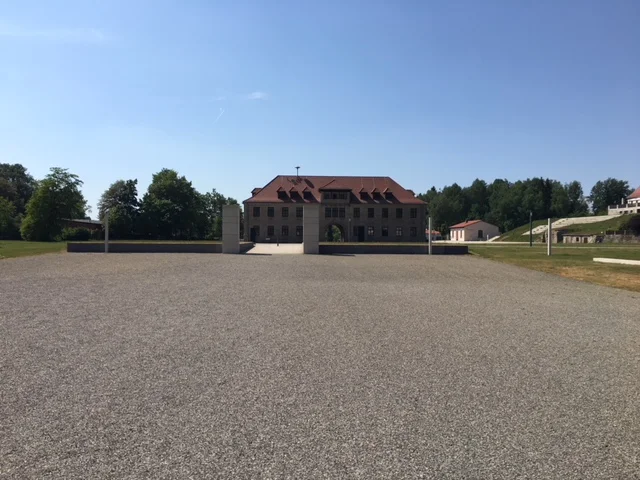
Not far from where we live, about a half hour, is the Flossenbürg Concentration Camp. Unlike Auschwitz which was a death camp, this one was "merely" a labor camp. The main emphasis here was labor and not eradication although it served both purposes.
Quite some years ago I first heard of the theologian Dietrich Bonhoeffer. He could be considered a German theologian though he was born in Poland since at the time of his birth Poland was swallowed up by Russia, Prussia (later Germany), and Austria-Hungary. When I began researching my soon to be home before moving on a whim I searched for camps and saw how close Flossenbürg was which in turn let me to a brief search on it and discover that it is where Bonhoeffer was held and executed. Not that a camp needs to have a "most famous" inmate, but he would certainly rank as among the most well known.
One of the few things my Dad wanted to see on his visit was a camp, so I used this opportunity to finish the observational experiment started two years before. At the start of Dad's trip we visited Nürnberg and went into the Congresshalle. As the largest piece of Nazi architecture left, it has been made into a very well done museum. There is a steel and glass shaft-like protrusion that seems to pierce the building and as you make your way through the exhibit you end up at the tip hovering over the open air, bombed out courtyard that would have been a stadium covered portion of the complex. The displays were very well done and didn't display either pride or necessarily shame in what was done. Rather they were informative and explained how what happened had. But the center courtyard, that was different.
After touring the displays that showed before, during, and after pictures you make your way to the center where the bombed out building was left. Very stout building, so it isn't crumbling, but the pockmarks, the grass, trees, and even weeds growing in the center of this building is very much a middle finger in the air to the bigoted shitheads that built it. I know I've used that phrase before, but it is just as accurate here.
There was a display about the building which also mentioned a spot nearby where they had constructed sample seats which, like all the buildings at the Nazi complex, had used stone quarried from Flossenbürg. So this served as a tie to the bookend excursions of the trip.
A colleague I work with from nearby Weiden told me he doesn't go to the city Flossenbürg because with the camp it just has an air about the whole town he finds depressing. He has even told me that when he goes into the woods nearby that the weather is colder and more repressive. That was not the experience I had though. We had the top down in the Peugeot as we cruised the backroads to the town. We parked at the bus stop and walked on to the site which was itself very strange indeed.
I mentioned in my Auschwitz post that someone lives right next door and can look down into the complex. In Flossenbürg they not only look down into the former camp, they knocked down most of the barracks and built houses on the site. A road goes through the houses and then through the site, there is no fence or barricade. There is even a restaurant that looks down into the site. The old wall is mostly gone, but several of the towers remain.
Walking through the few buildings that remained I didn't take many pictures. Until the end when I took pictures all the way back out. There were stories about the camp, it's history and growth, as well as detailed listings, pictures, and information about both the captors and the captees.
One particularly memorable "escape in place" attempt is chronicled well and also includes the spot in the wall he crawled and hid among the pipes between the floor and ceiling. It describes how he almost gave up hiding because the hiding place was as bad as being dead. I call it "escape in place" because he didn't go with them when they evacuated the Jews, rather he hid, then he was still open about being a prisoner but avoided detection as having been on the supposed to have been evacuated group.
There was an entire library full of books on the inmates of the camp. Famous or not, they have their histories indelibly inked as much as is known separated by country of origin.
In another spot there were plates with pictures and biographies of the camp's staff. Not just the head, but the guards. It talks of where they came from, where they went, if they disappeared later, and if they were discovered as several of the more cruel were.
The site still contains part of a prison complex (weird because the whole place was a prison) where the non-working laborers were kept, the laundromat/washroom, the kitchen, and the administrative SS Headquarters. Much of the city was taken over by the SS guards, but the HQ building is by far one of the nicest, most imposing structures that remain.
As I walked through the exhibits in the laundromat and kitchen there were paths to the parts of the building left un-converted. Some of the walls and floor were covered with glass, or metal grates, but it was possible to step off and into the spaces that had been occupied when the camp was operational. For example, the shower heads were removed, but the tiles on the wall and floor remained. I walked in awe examining the ceilings imagining when it was operational. Running my hand along the same tiles, walking the same floor tiles that seventy years ago had been touched and tread by the captive laborer prisoners.
The sense of tactile actions allows someone to become more connected to anything observed. I long to touch and become a piece of the historic and infamous locations I get to see. There was an authentic set of stairs with well-worn handrail full of patina that I slid my hand down imagining connection to the prisoners of once ago. In this manner I became a part of what I was observing.
At the back of the camp is what they called the Valley of Death. Overlooking it they have built a chapel but the Valley of Death is the part of the camp the town cannot see into from their bedrooms, or their front yard. Surrounded by trees and down a slope is where the worst things happened.
There are many monuments from countries honoring their dead. There is a HUGE mound covered in grass called the Mound of Ashes. It does not take a smart man to understand what lies beneath. A small field with concrete pads is marked as the location where executions by gunfire took place. And in the corner stands the crematorium.
At one point a railway track was added to ease the transportation of bodies from the camp to the crematorium which was really just outside the boundary fence of the camp. At this point the original gates of the camp were set up as the first memorial to the camp by former prisoners. These gates are right next to the crematorium.
My travels through the camp culminated at the crematorium. I walked past it a few meters to see the original camp gates. It is connected to the ubiquitous walking trails throughout this country. This one through the woods. Unlike the last crematorium I was in at Auschwitz, this one had not been destroyed by retreating forces. It had been in operation when the camp was liberated. Inside were the small rooms where bodies had been stacked and prepared for burning. And the ovens themselves.
I did not use my sense of tactile connection in this building. I have no desire to be connected to the folks that orchestrated this travesty. I care not if they were following orders, or even if they themselves were prisoners forced to toil away at the macabre task. The despair and gloom Klaus made reference to centered on this spot. I could feel it here.
On the way back out, I took pictures to chronicle my visit and to use when I explained it. Previously I had no desire to visit another concentration camp. Currently I still had no desire to visit this one twice.
One thing that was poignantly different was that here I found out that after the war the courts extended the statue of limitations to allow prosecution of Nazis involved in concentration camp atrocities. Many of the guards that had disappeared were found years later and recognized by the former prisoners and brought to justice.
Justice here is used rather loosely though. While many were convicted and even sentenced to long terms including sometimes life, most got out after three to ten years. It has taken me quite some time to process the fact that after the war the only people that really had the heart and desire to go after and prosecute were either victims that had survived, or family members of victims that had perished. The country wanted to, needed to, and did move on. They didn't brush it under the rug and forget about it per se, but the overwhelming desire was to get on with correcting the path of the country. It was not, and is not, a sense of ignoring the past, but not vehemently punishing those that did what was done. I'm still not sure I have processed that level of information.
One thing that I am sure of, this visit helped me to better understand what happened afterwards. It helped me in processing my thoughts of the first visit. I finally finished and posted my Auschwitz visit after seeing this site.
When I got here I was told that the Germans don't like talking about this 12 year period of their history. There are thousands of years of history to discuss instead. But if it were not for this 12 year period, I would not be here today. The reason I can work here is due to that time, so it is incredibly interesting and necessary to view for me. But in the minds of modern Germany it is like Alsace and Lorraine were from 1918 on, spoken of never, but thought of always.


End to Prejudice
Few things make us feel as good as finding others that think like us. When a quote from a famous person matches our feelings it seems to drive home the point that much better. As a general rule I would say that had we found the quotes before the underlying concept they may not have as much an impact on us but I challenge any who disagree to comment.
I have long loved to travel. Whether it was to my aunt and uncle's house in rural LA (that's the original LA, Lower Alabama), or to family reunions in central Mississippi, of course trips to New Orleans, Mobile, and Atlanta were always full of new things too. Once I reached a point I could truly set out into the world those trips became longer and more fascinating.
Early on I had found Innocents Abroad, but found the film adaptation (perhaps it was a PBS adaptation) to be more interesting than the book, a rare occurrence for me. It tells of Mark Twain's adventures when he convinced a newspaper to pay him to see the world. This is a step away from con man but I leave it to the individual to decide if it is above or below. My own interpretation is clear as I have regularly used my employer as a means of funding my trips to other parts, of the state, of the country, and of the world. It was only once I had reached a Twain level of employer-funded jaunts that this quote knocked me off my feet.
Travel is fatal to prejudice, bigotry, and narrow-mindedness, and many of our people need it sorely on these accounts. Broad, wholesome, charitable views of men and things cannot be acquired by vegetating in one little corner of the earth all one’s lifetime.” —Mark Twain
No less accurate is his quote from On Life, "The two most important days in your life are the day you are born and the day you find out why." but these are days that can occur at home. One by definition would occur where you are from, but the other may well be after you have begun to knock the prejudices of our upbringing off of your character. But by that point we should realize a little better what Hemingway was talking about.
"There is nothing noble in being superior to your fellow man; true nobility is being superior to your former self." —Ernest Hemingway
In many ways this blog has become my own version of Innocents Abroad. I have chronicled my travels and noted my observations on employer funded, as well as personal funded, jaunts of various lengths, distances, and durations. As they began I felt uncomfortable. I could feel my comfort bubble if not bursting at least being left behind. In many ways I am more comfortable outside my bubble than I was inside it. Perhaps the most shocking revelation to me was a quote I stumbled upon more recently.
“The American is always an alien abroad. He never can assimilate nor do other peoples ever accept him otherwise than as a foreigner. His own heart is in his own country, and yet there is less and less of a niche for him when he returns.” —Herbert Hoover
Whether the comfort bubble has popped, expanded, or merely been exceeded, life outside is an incredible place to be. You never know what tomorrow may hold. You never know what is around the next corner. And you never know what may happen when you return back home. Rest assured though, as your world expands, your narrow-minded petty thoughts are wont to disappear.
Lunar Dreams
The longest blood lunar eclipse of the century is ending. I’ve always looked at the moon. The moon and the stars. My Dad was a telescope nut. Still is. In 11th grade he built a telescope and took it all the way to the national science fair. Growing up I looked through that 8 inch reflecting telescope many nights.
The moon, Saturn, Jupiter, Venus, Mars, comets, anything celestial we watched. At 4 am he would wake us and drag us across the street to Uncle Jimmy’s yard, the highest point in town, where we’d lay out on lawn chairs, towels, or just the dewy grass and watch meteor showers twice a year. Sometimes more.
I always look for a flag. You can’t see them. Even if they weren’t bleached out from decades of ultraviolet radiation. I still look. I found an online aerial map of the moon, browsable, a Google Earth for our satellite if you will. Excitedly I looked up the latitude and longitude of my favorite mission, Apollo 17. I zoomed and panned, zoomed and panned and finally got to the spot. It was fuzzy resolution but you can make out the legs of the lunar module, the flag is kind of visible but no details, there are spots of equipment and tracks foot and buggy. Happy and content I sat back and clicked a few other controls where I stumbled upon the button that turned on the highlight locations. Such as the lunar landings. Nerd that I am I did it the hard way.
So tonight I did my other long standing tradition. As the trailing edge of the earth removes its shadow from the moon I looked to see features. Someone walking around, waving, or maybe just a building, a mountain, anything. But alas it is not there. Somewhere along the level of flags are the wistful dreams of seeing an earthen feature shadowed on the lunar surface.
There wasn’t one tonight. Only the wispy waves of atmospheric interference. And now the eclipse is all but over. No more opportunities to see. But I’ll be back. I’ll look again. Until I get to see the shadow of a tree.
The Circle is a Bubble
During my visit to the US I had a chance to sit with my Dad and two uncles. An impromptu meeting in a gas station deli with the best oyster poboys in Biloxi. A table full of Byrds is a dangerous place to be.
When I started typing this I got off onto a bit of a tangent which led me to describe my Comfort Bubble. Eleven hundred words later I still finished it up with "that's my bubble in a nutshell." I'm reading a book of essays by and about Southern Writers and one essay I read said that we Southerners tell stories. It's just what we do. To illustrate the point the author, Joe Formichella, told a story about his older brother visiting Myrtle Beach and attempting to order a piece of pie. Describing the encounter he said that after listening to the ". . . history of its origin, a cautionary tale about its proper pronunciation, a dissertation about the preferred method of eating it, 'When all I wanted was a goddamned piece of pecan pie!'" Seems right.
Back to your piece rather than my whole pie, I grew up in Biloxi with my paternal grandparents two blocks east and maternal grandparents six miles west. My Dad was the middle of seven and my Mom the middle of six and most all of them still lived in Biloxi. Across the street was my Uncle Jimmy, whose wife was Daddy Byrd's sister. We're Southern, we know what Great Uncles and third cousins are, we just don't mention the details unless we have to. I knew four of my great grandparents, and lived in a house that was another set of great grandparent's house before they passed. I didn't know everyone in the town, but there could not have been more than four degrees of separation from knowing any of them. The way I describe it is that there were 50,000 people in Biloxi and my Dad knew all 70,000 of them.
The Biloxi of my youth was not a huge town, even though it was the second largest in the state. It had not only a hometown feel but a welcoming home town touch. It was easy, especially with my familial connections, to think the whole world knew itself. As a fifth generation Biloxian, I never imagined living anywhere but Biloxi. Once I left I've never imagined moving back.
No matter how far away I've been I always have to go home and recharge my Biloxi Battery. It was more frequent at first, and never takes real long, but it's a must. Several years back it finally struck Ginger who said, "No matter where we live, no matter how long we've lived there, you will always call Biloxi home." She knows me better than I do. I've taken to telling people I'm from Missibama because I've lived in Alabama about 4 months less than I lived in Mississippi. More accurately I'm from the whole Mississippi Territory. But Biloxi is my home.
We once traveled 350 miles for a pizza. A Hugo's Pizza, the establishment that brought french dressing to pizza, ask any old school Biloxi resident they'll tell you. I can still taste that 18" shrimp pizza even though I think they closed before Katrina wiped out the building. Traveling 5000 miles for an oyster poboy doesn't seem that far fetched to me. I try not to tell Ginger that's the point of the trip and she acts like it isn't so we're all good. But part of the reason I can travel intercontinentally for a meal is that I know I'll get to recharge my battery and see at least some of my huge family.
This trip was no exception. Of course Dad was there, and Bea who had traveled with him to Germany for 2 weeks in May. Then Uncle Doughnut showed up. Things were going great when Uncle Pat called so he headed over too. Now we're having an impromptu family gathering in a gas station. Bea and her granddaughter left, then Faith and Ginger went out to the car leaving two generations of Byrd Boys shooting the breeze around the table.
It comes as no surprise, but I talk. I talk a lot. It surprises people when I tell them I want to kiss the Blarney Stone because they can't believe I haven't already. But I also listen. I listen more than anyone who talks as much as me can. Listening to two conversations at the same time is easy. The problem is that at some point you will be drawn into one conversation over the other and you can't tell when (or where) that happens. In Afghanistan I had one 12 second interval where I was listening to one conversation in my right ear, one in my left, and talking to a guy in front of me. After 12 seconds I told everyone to quit because I will never be able to top that.
Part of the listening is paying attention. In the midst of our conversation I noticed that my Dad was more quiet than he normally is. Not sure what's going on there yet. I think we all kind of deferred to Uncle Pat a bit. My Dad wasn't the youngest, but he did seem to have the least to say. I suspect he was recharging his battery, too.
The interesting point that started this whole post was something Uncle Pat said. He talked about some of the things he's lived through, especially the civil rights movement, and said that everything is a circle. It all comes back around. And now, even that is coming back around.
The first instinct may be to say that no, the civil rights movement is not coming back around, but before you say that think in terms of parallels and equals. In many ways there are similar situations happening. And it's uncomfortable. The world of political correctness and offense over words taken out of context is immensely uncomfortable. The words taken in context are often poorly formed. And with the age of instant notification a misspoken word can be sent around the world in a hundred different ways before the smell of expulsion of words has dissipated.
I'm reminded of a line from one of my favorite poems. I don't like much poetry, I don't read much poetry. Taking it out of the whole could mean taking it out of context but the line is "Success in Circuit lie."
Life outside the comfort bubble is by definition uncomfortable. No matter how one defines the bubble. Sometimes the bubble defines you no matter how hard you try to avoid it.
Tell all the truth but tell it slant--
Success in Circuit Lies
Too bright for our infirm Delight
The Truth's superb surprise
As Lightning to the Children eased
With explanation kind
The Truth must dazzle gradually
Or every man be blind--
Emily Dickinson (1263)
Auschwitz
This was is near to my heart. Partly because I got to share it with my daughter, but mostly because of where we went.
Typically speaking, when one sees or experiences something it is best to record your thoughts as soon afterwords as possible or else something may be lost and forgotten. But there is nothing typical about a trip to Auschwitz. I started this description not long after our visit in 2016 but did not complete it or post it. Now, after 2 years and a visit to another camp I have returned. No less changed and no less awed by the power of the visit.
Joseph Stalin is reputed to have said “One death is a tragedy; one million a statistic.” I say reputed because the exact wording and context are not known as well. Also at issue is whether or not he was the first to espouse the concept. He was not.
In 1759 Beilby Porteus, who later went on to become the Bishop of the Church of England, wrote Death: A Poetical Essay in which he said:
’Twas not enough
By subtle fraud to snatch a single life,
Puny impiety! whole kingdoms fell
To sate the lust of power: more horrid still,
The foulest stain and scandal of our nature
Became its boast. One murder made a Villain,
Millions a Hero. Princes were privileg’d
To kill, and numbers sanctified the crime.
Ah! why will Kings forget that they are Men?
And Men that they are brethren?
This is a sentiment that was repeated by Charlie Chaplin in Monsieur Verdoux in 1947: “That’s the history of many a big business. Wars, conflict, it’s all business. One murder makes a villain, millions a hero. Numbers sanctify my good fellow.”
Mother Teresa, whose canonization for sainthood is likely to be soon, once said, “If I look at the mass I will never act.”
If Mother Teresa and Joseph Stalin seem to agree it gives pause for thought. Bishop Porteus echoed in a Charlie Chaplin movie may seem a stretch, but Chaplin shared a birthday and had his trademark mustache copied by a man who would be king. A man who thought himself a hero. A man who made others think him a hero. A man who forgot he was a man, perhaps on purpose.
From the text of affidavit signed by Rudolf Hoess on 5 Apr 46 the former commander of Auschwitz estimated at least 2.5 million victims were executed and exterminated by gassing or burning, and at least another half million by starvation or disease making a total dead of 3 million. Hoess estimated this to be 70-80% of the people sent there as prisoners. Maybe he overestimated, maybe he couldn't count, but never forget, these fuckers kept meticulous records even though they began to destroy them when the enemy was at the gates.
The sheer magnitude of what occurred numbs the mind. The surreal power of the place 70 years later has the same effect.
By the time we arrived in Oswiecim, Poland it was not a dark and stormy night, but it was a dark, wet, and dreary night. The view from our window at the Hotel Galicja had two deserted loading docks on one side and a big empty field with a well worn footpath alongside a babbling stream. The overcast fog and light drizzle covered the cold night air. The tone was well set for the next day's event.
The sunrise brought no relief. The sky was overcast and gray with a light sprinkling of rain. The temperature was cold, downright bone chilling. There could be no better weather for a visit. This is a place I never in a million years imagined I would be. But here I was with my seventeen year old daughter, Lizi.
Germans had a history of renaming Polish towns even before they were a country. But this was different. The town was renamed by the Nazi invaders who then used on the camp. Over the course of the camp’s existence they also removed the inhabitants of the town and brought in new settlers. They were removed partly to keep secret what was happening, partly to keep residents from helping escapees, and partly because the whole justification of taking over Poland was to provide liebenstraum for the German people. Not so much to subjugate the people as to eliminate and make room for agriculture to provide for the Reich.
It began as a Polish military barracks, evacuated and abandoned but repurposed as an overflow location for the town’s prison facilities. As the former allied Soviet Union was turned on by the Reich, Soviet prisoners of war were interred as well as interned there. The list of prisoners continued to grow to include Jews, Romanies (Gypsies). Contrary to Hoess's numbers, it is estimated to have contained 1.3 million people over the course of its lifespan. Lifespan doesn’t feel appropriate yet there is no antonym that does.
Of those people, 1.1 million perished. By gas, by starvation, by lack of oxygen, by disease, by hanging, or by being shot, there was little difference how. Most of the rest were shipped to other locations deep in the Reich as the Red Army advanced late in the war. The crematoriums and gas chambers were sabotaged or destroyed. The wall where prisoners were shot was torn down. The gallows were removed, and many records burned to hide what had happened. A mere 7,500 remained to be liberated, 500 of which were estimated to be children. For all its infamous brutality it had been an efficient extermination center.
The best way is to reserve a tour guide which takes several days advance preparation. While we knew when we were going, by the time we looked there were only Polish and German slots available and even then only one each. There are also 6 hour and multiple day introspective tours given but we knew those were not for us. The gates opened at 8 but you have to enter before 10 or after 3 if you tour at your own pace.
Walking up you can see the buildings and the fence. The iconic concrete post, barbed wire fence. Rusted, weathered, dirty, and in places moldy. Some features and buildings were recreated or rebuilt, some were restored, some were left in their original condition. The fence was original. The surreality of it began to hit as we walked up to a trailer that said “Info” to get our tickets. This was not a place that topped the list of must see locations but it was certainly on the list of places I never imagined I would ever be able to see. Standing in line memories popped into my head, Mr. Belvel’s history class, black and white newsreel films, The World at War on PBS, Schindler’s List.
The bookstore had tour guides and more. We entered and looked at the books while the cashier completed the transaction with the three guys at his counter. Most of the books were sterile and un-attractive bindings. There was no brightening up the subject matter. I grew up in a tourist town. Normally doing tourist activities are things I’ve seen others do and recognize but haven’t participated in myself. As we turned to the cashier I could tell he was good. He had laid out pamphlet and handed us a tour guide as he explained the pamphlet and another I swear he materialized from his hand. The documents were all in English. We’ve gotten spoiled since almost every German we have dealt with since moving spoke our language, too. In Poland it was not the same. It took 4 people to take our order at McDonald’s but here this guy knew tourists. After we walked out I remembered that now I would have to carry the books and DVD through the whole tour but how to do that was secondary to the entrance.
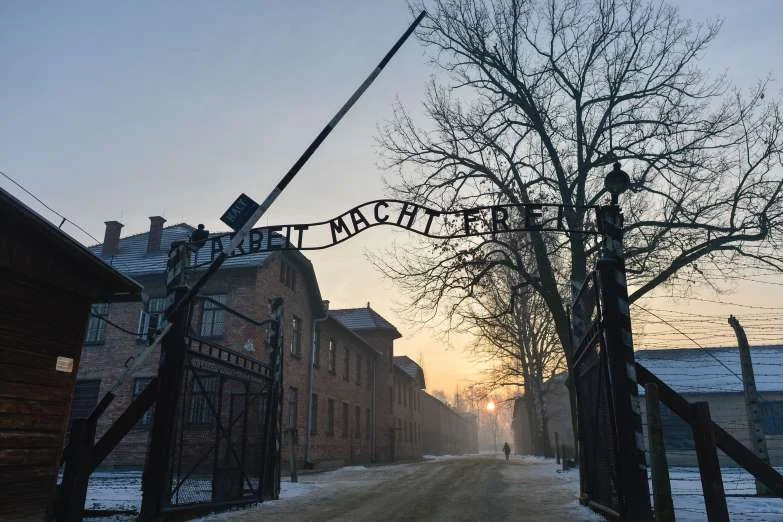
Arbeit Macht Frei.
Maybe it was intended to be true when it first went up. Maybe it was a psychological ploy to give the semblance of a chance for freedom. Maybe it was just a promise that would never be fulfilled. Maybe it was intended to be just what it is: a symbol of what lay ahead, a sinister sick joke to say abandon all hope ye who enter here. But there it was. As large as life. Life sized. Again life seems a word that should not be used to describe the structures of this place. In person, not fabricated, not on television, not in a movie, not on a grainy black and white PBS special. I touched the gates of THE symbol of terror, genocide, and the Holocaust.
There were many exhibits set up in the former barracks. One block was set up for each group of detainees: Soviets, french, Belgium, Netherlands, Romanies. I could easily spend a paragraph on each and it would never be enough. In the Hungarian display there was the sound of a heartbeat. Eerie, spooky, and chilling. In the french and Belgian display they had train sounds and a plexiglass covered set of tracks depicting the cattle cars that brought the prisoners in.
At a display of uniforms there were many original sets of clothes hung on makeshift frames behind barbed wire. Unlike the United States, in Germany they do not protect you from yourself. If you want to do something stupid (or against the rules) you can. Tactile memories can make one feel a part of what went on and I find myself touching the wall, or the stair rails, or whatever historic venue I happen to be at. These uniforms were not for touching. I didn’t touch the closest ones, I bent over as far as I could and grabbed one. The coarse weave of the material had a utilitarian, uncomfortable feel to it.
Outside Block 11 there were a family of owls living. Block 11 is where most of the executions were carried out. It is where the first test of Zyclon B was done. It is where the optimal density, timing, and amounts needed were determined. Owls hoot into the now silent building of such suffering.
We were traveling alone, just the two of us but there were may groups there. For the most part we tried to avoid going into buildings with them. It did not always work. In one building we failed miserably to avoid them. Even with ventilation and lighting it was dark and stuffy, especially with too many people.The mass of people filing through the basement was bad. Slow, shuffling, muffled. No one spoke. One line headed down the hall another back. But we had space. Personal space we all gave each other as much as possible. As close as we would get to what had happened, yet not. It would have been indescribable back then. Downright claustrophobia inducing.
We walked between the buildings where most of the executions were carried out. And past the gallows, and the daily roll call. The condition of the roads was similar to what it was 70 years ago. Gravel with imperfections, potholes with water. Misty rain. It reminded me of the Rudyard Kipling story that convinced him to be against capital punishment where a man, literally on the way to his death, avoided a puddle.
There was a display of cloth made entirely of human hair. It was not a small bolt. There was a tangled mass of wires that when you got close to it were wire-rimmed glasses. Thrown there because their owners did not need them any more and they would not burn. There were rooms full of pottery, family heirlooms, and my God the luggage. Suitcases with the hopeful, hastily scratched addresses of their former owners on them. Hopeful because they believed they would be reunited with them again. And the room of shoes. If I one day honed my writing craft to the level that earned me the Nobel Prize for Literature I would never be able to describe the room of shoes. Not a small room, a hallway lined on both sides with an unimaginable pile of shoes. Except for one detail. It was imaginable because it exists. It sits there behind glass paned windows for all to see.
At the tender age of 14 I read Poland by James Michener. In it he describes an event based on a true story of a room in the basement of Auschwitz where the guards crammed more people than could fit. One small window provided all the air the room would receive yet the cruel men in charge locked the door and left. In the story a priest told a man the fool’s move was to fight for a spot at the window to breath, better to hang back by the door. There would be room, not much air but room. At the end of the night, the man survived along with the priest. There were not many more that walked out alive.
I saw that room.
I cannot recall if the room was accessible, but I know I came nowhere near that window. I stood at the door and could not imagine a more poignant moment to bring home the power of what this place was. I was wrong.
Near the end of our tour we came to the gallows beside the cremation chamber where Hoess had hung. He was hung within sight of the barracks, beside the cremation chamber, while being able to see the very location he and his family, his wife, his children had spent their lives, cheerily. That fucker hung until he ceased to breathe and he got off easy. While I enjoyed reading about and seeing where he had lived his last second something else happened. As I finished taking a picture I looked for my daughter. She was nowhere to be seen.
I had lost my child in Auschwitz. At the crematorium.
Full on panic set in. Hurriedly scanning the crowds. Running to the other end of the line of people walking somberly, soulfully, and mournfully from barracks to gallows to crematorium entrance. No sight of her.
Backtracking I stood on a small hill and looked in every direction. Nothing. Ran to the other end of the sidewalk and another hill. Nothing. The hill was the crematorium but not the point. She was not there.
As she emerged from the exit of the crematorium my heart began to beat again. She told me she went on through, so I asked if she wanted to wait while I did. Without hesitating she said no. Arm in arm we walked into the crematorium.
In the face of the advancing Soviets this crematorium had been destroyed. The callous cretins knew they were doing things they should not have done because no one hides if what they’re doing is right. They were unsuccessful. As a part of the memorial it was restored to safe conditions. Safe. A truly relative term. The rooms were there. The ovens. The rails and carts that made the task easier. After we came out Lizi told me that there was one place in particular that gave her the shivers. It did so both times.
So we walked out. Like a mere 0.25% of the former occupants had.
The tour guides online all said to allow 90 minutes each for Auschwitz and Auschwitz II-Birkenau. We spent four hours in just Auschwitz. On the way out I commented to Lizi who said it didn’t seem that long. When asked how long it had been she said no more than three and a half tops. But it was four, long, surreal hours.
Next door to Auschwitz is an apartment complex. And I don’t mean a few hundred meters away. I mean right there at the wall, a parking lot or less away is an apartment complex. Several stories high, which means that there is someone who looks out their window and can see over the top of the wall, over the barbed wire, and into the heart of the barracks of this former extermination camp. I think I would rather live in a cemetery homeless.
Over the course of my life I have experienced prejudice, sexual harassment, and discrimination. I have been racially profiled and even pulled over for driving while white. I have not complained or pushed these incidents because I know that the intensity of them is nothing compared to what others feel. It is just as wrong, but not on an equal level. I know my experiences at this camp of death does not rise to the level of any given Tuesday when it was in operation. But they are no less powerful for having happened to me. If anything it has strengthened my resolve to meet someone who has experienced this nightmare firsthand.
There is so much to hate about what is and what was done in this place but one thing that struck me was at the entrance. That powerful, symbolic entrance gate, in harsh black letters, Arbeit Macht Frei, has a crowd control black and white barrier similar to many roads, sidewalks, and paths around the country. One that means do not enter, or when up to come on in. There is such a pole at the iconic gate. There is no way to photograph the gate without the pole. This got me to thinking and in the time since our visit I have gone back to see and notice this pole. It is always there. In every shot. Every video, every photograph, omnipresent. And always up. Presumably they close the arm, why else have it? But they do not allow anyone into the grounds without opening it. Even the private photographers that come before or after visitors. It. Is. Always. There. It is a giant middle finger sticking straight in the air to say youu made this a place of death and despair now fuck you we have gained our freedom.


Meeting around the world
I have long said Serendipity takes me everywhere. From time to time I have an incident that I can use to prove it. Yesterday was one of those incidents.
On the way back from the US last Saturday I began talking to a guy sitting behind me. I had flown from Mobile to Houston from which the flights would go to Newark then Munich. This gentleman and his wife were headed to Geneva but would be in Berlin the next weekend. My plan was to either go to Muenster to see the Anabaptist cages atop the steeple or to Berlin so I mentioned I might be there, too. He gave me his card and after landing in New Jersey went our different ways.
Friday night I looked at the map, Berlin is a huge city in case you didn't notice, and saw that where I figured our bus would be was near their hotel which in turn was near the two sites I most wanted to see. Unfortunately I missed both but that's a different story. I emailed him in the hopes that we might meet up to break bread or at least have a coffee or beer.
Upon arrival in Berlin we had a native Berliner (not the doughnut) join our group and took a tour of the whole city. We made stops at the Brandenburg Gate (where I hummed the Concertos, thank you Mr. Blessey), the Wall, and Checkpoint Charlie.
At Checkpoint Charlie I walked around and took in the sights. I found it particularly interesting to watch one lady drive through the intersection without even checking up on the gas going from the former West to former East Berlin. Arriving back at the bus I had about 5 minutes until we left when I thought to check my email again. He had responded about forty-five minutes before and said they'd be at Checkpoint Charlie for about an hour.
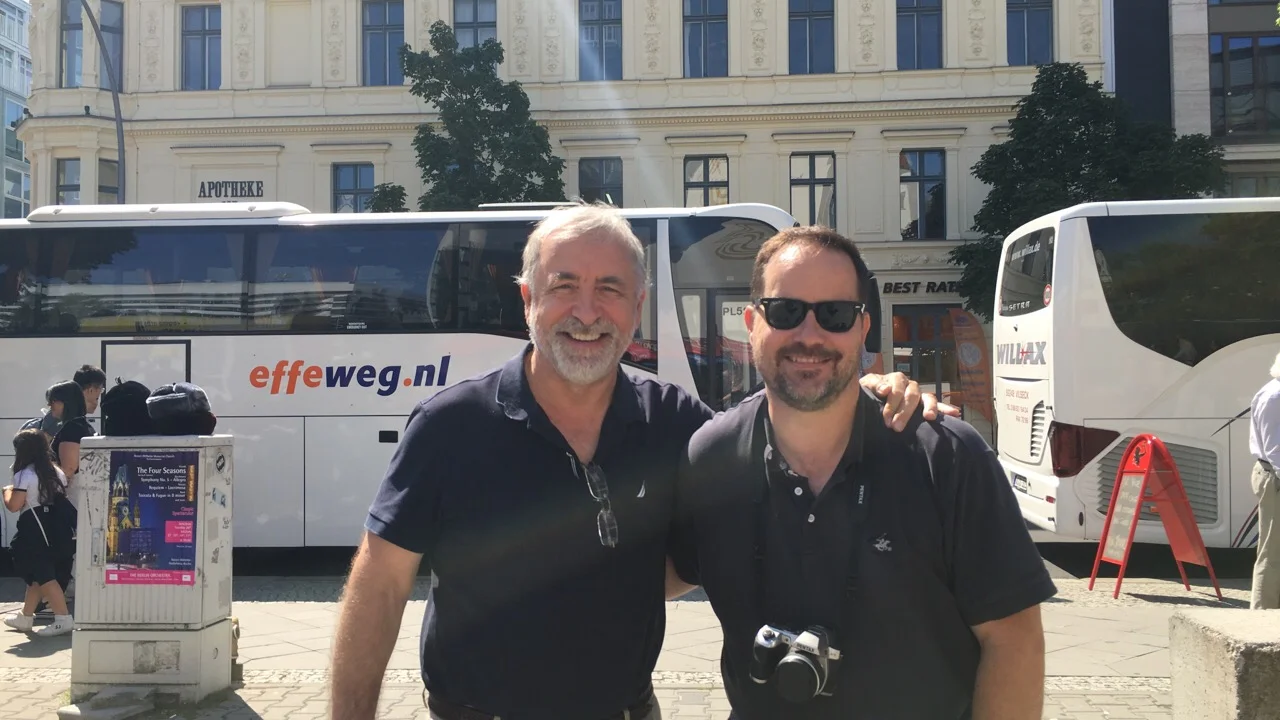
Hastily I went to my other phone where I had saved his number and to my dismay I did not save the number just the email. As I reached into my pocket to pull out his business card, who do you think walked in front of me? Mr. Lopushansky.
We only had a few minutes to laugh and comment about the unlikeliness of what had just transpired. He had just told his wife something told him he needed to go across the street when they met me. She took our picture a few times and we shook hands. We both parted with a smile on our face and the thought in our minds that no matter how much of this great big world we see it just keeps getting smaller and smaller.
Driving
While not being able to sleep this morning I stumbled across my Scrivener file full of notes for writing about Germany. Some of them I’ve used already but some still sit patiently for me to more fully flesh them out. This is one of those topics.
I am a Traffic and Transportation Engineer. It’s just what I am. I don’t get to work much in that field doing what I do for the Corps of Engineers, but that changes nothing. So of course my first observations about Europe involved vehicles and the driving experience.
For one thing, they put the traffic signals too close to the stop line here. Most Germans stop well short of the line so they can see but as Americans who are used to being right there at the line we pull up then lean over trying to get a look. The funny thing is that we do that in the US to minimize the lost time—the time between the light changing and vehicles moving. But here, before the light changes to green it changes to yellow giving a warning that it’s about to happen. I had long theorized that a similar action would help, coming here I learned it absolutely does.
In france, they add small lights at the base of the pole. At first I thought this was great because you can see without hunching over, but in Paris in particular this is unnecessary. You do not need to pay attention to the lights at all because when it turns green some frog behind you will honk. Whether the intersection is clear or there is a tangled mass of cars in both directions interwoven in such a way that no one can move. Which happens a lot. By the way, my advice about driving in Paris is never do that.
An adjustment though, is no right turn on red. The only positive thing California has given to traffic flow is not allowed here except in very limited circumstances. And by very limited I mean mostly only on the American installations but not even all the time there. Hard to get used to.
And no, the California roll stop is not a positive contribution to traffic flow.
People here use turn signals. Like they’re supposed to. All the time. And no one drives around with their parking lights on. Ever. Also, no one drives with the hazard lights on unless there is a hazard. If you see hazard lights in front of you one of three things has happened: they’re on the side of the road because a vehicle is broken down, a slow moving vehicle or truck with trailer is ahead of you (like 50 kph below speed limit slower), or all the traffic in front has stopped and the vehicle has put on the hazard lights to warn you that you’d best slow down because you’re about to stop. FYI, literally going 90 to nothing stinks. Going from 150 kph to 0 kph because of a stau means that all the time you just knocked off your GPS estimated time of arrival is about to get added back on.
Few people realize this, but in the United States there is never an instance when you have the right of way. Technically, you only have the right of way yielded to you. There is no textbook, driver’s manual, or law enforcement training that will ever say that one vehicle has the right of way over the other, only indications of which vehicle has to yield. That is not the case in Germany. In Germany vehicles often get the right of way. Occasionally they brazenly advertise the fact that they have it, but rarely. More often than not the most you get is a stern glance or dirty look from another driver because they had the right of way but you took it. Civility rules the day. If there is a car on your side of the road parked, the oncoming traffic goes until there is no more, then you go. If the lane merges into the lane on the right or left you drive to the merge point where one car from each lane goes at a time. Uniformly, civilly, logically, and as a traffic guy I’d say beautifully.
On the autobahn things flow nice. People are not afraid to pass up a Polizei vehicle. Even when you’re driving faster than 90 mph. For my part I have approached them at over 100 mph but always slow down to between 90 and 100 mph because it just doesn’t feel right. Sure is nice to not have to clean out my shorts afterwords though. People only pass on the left, because it’s the law. They stay to the right, because it’s the law. They also build the lanes anticipating that most traffic will be in the right lanes rather than a uniform thickness as we do in the US but that’s a different matter. Strangely enough, if you absolutely have to pass on the right (because you’re that big an asshole) you pass on the shoulder. First it’s not a breakdown lane because you can get fined for breaking down on the autobahn, but second, passing on the shoulder is improper lane use which is a cheaper fine than passing on the right.
I also happen to be a pedestrian expert, though I don’t like to walk myself. Germany is full of walking and biking paths to include lanes on the road and an awesome interconnected network of paths. One day while driving on a road through a field I saw a man with a walker out for a stroll. He was a good 500 meters from the nearest structure but he wasn’t headed towards it. He was headed further into the woods. These people take their exercise and outdoor time very seriously.
Another incident was when I was stopped at a railroad crossing in some out of the way town. There are few freight trains here, mostly passenger. They are all run by one company and would classify as a source of a blog post all by themselves but not my point here. While waiting a guy road up, this was about 2200 so 10 pm, on a bike smoking a cigarette. He didn’t light up when he stopped, he was riding and smoking. Here bicycles are not just for exercise, they are for getting around.
But overall I’d have to say that one of the first things I noticed that really stood out to me is the number of streets named Martin Luther. I’m used to streets named Martin Luther King, but here, they honor his namesake. A wide awake moment of realization that I’m not in Kansas anymore.